

MD&A · 2025
In this section4 topics
Overview of Operations
Overview of Operations
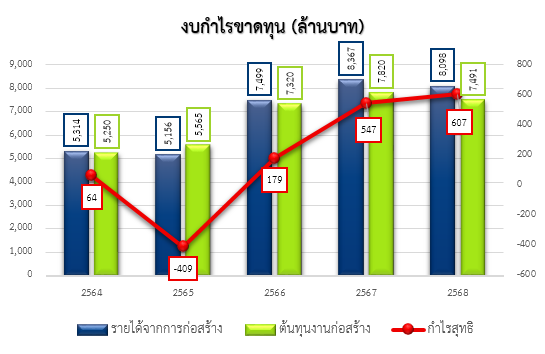
The consolidated financial performance of the company and its subsidiaries in 2025 showed a net profit of 607.07 million Baht, while in the same period of 2024, the company had a net profit of 546.94 million Baht, representing an increase of 60.13 million Baht. The increase in net profit resulted from efficient cost management, systematically controlling costs and operations in several areas. This began with planning from the procurement process, selecting material quality and price, and reviewing project budgets to align with actual construction plans in terms of both cost and time. Furthermore, actual costs were continuously monitored against the budget, enabling continuous control of expenses and performance tracking. Additionally, procurement and material management processes were improved for greater efficiency, such as planning orders in line with project schedules, negotiating prices with suppliers, and controlling material usage on-site to reduce waste. Labor and subcontractor management were optimized for work volume, and new technologies were adopted, leading to overall improved operational efficiency. This resulted in a 5.55 percent reduction in construction costs compared to the previous year.
Part 1: Construction revenue decreased by 1.07 percent from 2024, resulting from both external and internal factors. This small reduction indicates that the company has maintained its core customer base and most construction projects, but there has been a shift towards quality of work rather than quantity. Internally, the company has gained trust from both public and private sectors, participating in and winning numerous construction project bids. Additionally, there are several projects from 2024 (backlog) that are gradually recognizing revenue. Externally, factors contributing to the continuous recovery of the construction business include private sector construction investment. The value of private sector construction, encompassing both residential and commercial real estate, shows a gradual recovery trend, expanding by 3.0-3.5 percent in line with purchasing power and economic conditions in 2025, with other factors expected to follow.
Part 2: Revenue from accommodation services decreased by 4.56 percent from 2024, affected by several factors such as increased competition, the earthquake earlier in the year, and the fluctuating situation at the Thai-Cambodian border, which impacted the tourism and hotel industry, leading to a reduction in both Thai and international tourists. However, despite the decrease in service revenue, the company maintained its gross profit margin by controlling service costs. This resulted in an increase of 0.46 percent in the gross profit margin for the accommodation service business from 2024, and the group's average occupancy rate reached 76.74 percent.
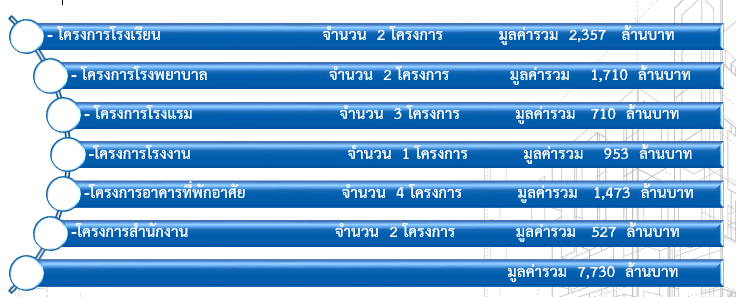
In 2025, the company had a backlog of sales awaiting recognition and delivery totaling 29 projects, with an estimated total project value of 24,653 million Baht. The remaining project value at the end of 2025 was 10,103 million Baht. Throughout 2025, the company continued to earn the trust of both existing and new clients, who continuously awarded projects to the company. This is attributed to the quality of the company's construction operations, the adherence to planned construction schedules at various stages, and the commitment to safety standards throughout the construction process. The company prioritizes correct procedures for the safety of all stakeholders, including personnel who must possess expertise and skill, and construction materials that must be tested and meet standards. This commitment is considered the fundamental quality standard that the company has always upheld in its operations, along with compliance with contractual terms, development of personnel and construction technology, and continuous adherence to business ethics. As a result, in 2025, the company was selected to win bids totaling 7,730 million Baht.
Construction revenue in 2025 amounted to 7,528.87 million Baht, a decrease of 81.15 million Baht, or 1.07 percent from the previous year. In 2024, construction revenue was 7,610.02 million Baht, and in 2023, it was 6,875.54 million Baht.
Service income in 2025 amounted to 451.34 million Baht, a decrease of 21.56 million Baht, or 4.56 percent. In 2024, service income was 472.90 million Baht. This decrease in income was due to a reduction in both domestic and international tourists, which impacted service revenue. In 2025, the average occupancy rate for the accommodation service business was 76.74 percent, a decrease of 2.16 percent compared to the previous year.
Regarding the ratio of construction costs to construction revenue, it decreased compared to the previous year. In 2025, this ratio was 87.98 percent, while in 2024, it was 92.15 percent, representing a decrease of 4.17 percent. This is because the company has planned to control the prices of construction materials, which are a major cost for the business. This involves analyzing trends in construction material prices alongside the required production volume, referencing market prices and market directions to aid in negotiations with suppliers for large orders, and making advance deposits for rebar purchases when market prices decrease, thereby maximizing cost management benefits.
The ratio of service costs to service revenue decreased when comparing years. In 2025, this ratio was 46.61 percent, while in 2024, it was 47.07 percent, representing a decrease of 0.46 percent. This reduction in the ratio was due to a decrease in fixed costs from asset depreciation compared to the previous year, and a reduction in administrative costs.
Operating Results & Financial Condition
Operating Results & Profitability
Revenue
The company's consolidated financial statements for 2025 showed a net profit of 607.07 million baht, while for the same period in 2024, the company had a net profit of 546.94 million baht. This represents a decrease in performance of 60.13 million baht, with the reasons for the change in operating results as follows:
Construction service revenue
Construction revenue decreased from the previous year, with 7,528.87 million baht in 2025 and 7,610.02 million baht in 2024, a decrease of 81.15 million baht or 1.07 percent. Revenue can be categorized by product lines as follows:
Revenue from direct contracting for residential buildings in 2025 amounted to 3,904.66 million baht, an increase of 739.09 million baht or 23.35 percent from 2024, and an increase of 1,813.50 million baht or 86.72 percent from 2023. This was due to 21 projects currently under construction, existing projects being progressively completed, and the commencement of 5 new construction projects during 2022.
Revenue from direct contracting for educational institutions in 2025 amounted to 1,223.85 million baht, an increase of 877.49 million baht from 2024, and an increase of 1,214.96 million baht from 2023. This was due to the company having 1 construction project with continuous revenue from the previous year and commencing 2 new construction projects during 2025, which are expected to be completed during 2026.
Revenue from direct contracting for hotels and resorts in 2025 amounted to 757.55 million baht, a decrease of 205.52 million baht or 21.34 percent from 2024, and an increase of 280.61 million baht or 58.84 percent from 2023. This was due to 3 construction projects with continuous revenue from previous years and the commencement of 3 new construction projects during 2025.
Revenue from direct contracting for office buildings / commercial buildings in 2025 amounted to 723.40 million baht, a decrease of 1,589.61 million baht or 68.72 percent from 2024, and a decrease of 2,706.01 million baht or 78.91 percent compared to 2023. This was due to 3 large construction projects with continuous revenue from previous years and the commencement of 2 new construction projects during 2025.
Revenue from direct contracting for hospitals in 2025 amounted to 549.10 million baht, an increase of 212.80 million baht or 63.28 percent from 2024, and an increase of 176.91 million baht or 47.53 percent from 2023. The company had 3 construction projects with continuous revenue from previous years and commenced 2 new construction projects during 2025.
Revenue from direct contracting for shopping centers / supermarkets / shopping malls in 2025 amounted to 259.10 million baht, a decrease of 213.47 million baht or 45.17 percent from 2024, and an increase of 27.80 million baht or 12.02 percent from 2023. This was due to the company having 2 construction projects with continuous revenue from previous years, which were completed during 2025.
Revenue from direct contracting for industrial factories in 2025 amounted to 95.52 million baht, an increase of 95.52 million baht from 2024, and an increase of 95.52 million baht from 2023. This was due to the company receiving 1 new project during 2025, and construction commencing during 2025, with the project expected to be completed during 2026.
Revenue from contracting for construction and installation of energy systems in 2025 amounted to 15.70 million baht, an increase of 9.41 million baht from 2024, and a decrease of 5.56 million baht or 26.14 percent from 21.26 million baht in 2023. This was due to the company winning bids for and undertaking 2 projects during 2023, and completing 1 project during 2025.
Revenue from direct contracting for DATA CENTER projects in 2025 was zero. In 2024, it was 6.86 million baht, and in 2023, it was 244.41 million baht. This was due to the company winning a bid for and undertaking 1 project during 2023, which was completed in 2024. Currently, the company is in the process of participating in new bidding.
Product Line/Business Group | Year 2023 | Year 2024 | Year 2025 | |||
Amount | % | Amount | % | Amount | % | |
Revenue from direct contracting | ||||||
Residential buildings | 2,091.15 | 27.89 | 3,165.57 | 37.83 | 3,904.66 | 48.22 |
Educational institutions | 8.89 | 0.12 | 346.36 | 4.14 | 1,223.85 | 15.11 |
Hotels and resorts | 476.93 | 6.36 | 963.06 | 11.51 | 757.55 | 9.35 |
Office buildings/Commercial buildings | 3,429.41 | 45.73 | 2,313.01 | 27.64 | 723.40 | 8.93 |
Hospitals | 372.19 | 4.96 | 336.30 | 4.02 | 549.10 | 6.78 |
Shopping centers/Supermarkets/Shopping malls | 231.30 | 3.09 | 472.57 | 5.65 | 259.10 | 3.20 |
Industrial factories | - | - | - | - | 95.51 | 1.18 |
Energy systems | 21.26 | 0.28 | 6.29 | 0.08 | 15.70 | 0.20 |
DATA CENTER | 244.41 | 3.26 | 6.86 | 0.08 | - | - |
Construction revenue | 6,875.54 | 91.69 | 7,610.02 | 90.95 | 7,528.87 | 92.97 |
Revenue from room services | 423.73 | 5.65 | 472.90 | 5.65 | 451.34 | 5.57 |
Revenue from energy business | 6.90 | 0.09 | 6.25 | 0.07 | 5.85 | 0.07 |
Interest income | 1.28 | 0.02 | 4.76 | 0.06 | 7.60 | 0.09 |
Reversal of expected credit loss allowance | 54.66 | 0.73 | 50.86 | 0.61 | 7.27 | 0.09 |
Gain on disposal and write-off of assets | 12.93 | 0.17 | 9.51 | 0.11 | 5.89 | 0.07 |
Gain on disposal of investments | - | - | 87.17 | 1.04 | - | - |
Other income | 123.98 | 1.65 | 125.86 | 1.51 | 91.11 | 1.14 |
Total revenue | 7,499.03 | 100.00 | 8,367.33 | 100.00 | 8,097.93 | 100.00 |
The company's net total revenue (according to consolidated financial statements) in 2025 was 8,097.93 million baht, compared to 8,367.33 million baht in 2024, a decrease of 269.40 million baht or 3.22 percent. The main revenue source was from direct contracting, amounting to 7,528.87 million baht or 92.97 percent of net total revenue, derived from residential buildings, educational institutions, hotels and resorts, office buildings, hospitals, shopping centers and malls, industrial factories, energy systems, and data centers, respectively.
Revenue from room services
The company had revenue from room services of 451.34 million baht in 2025 and 472.90 million baht in 2024, a decrease of 21.56 million baht or 4.56 percent. The average occupancy rate of the group decreased from 78.90 percent to 76.74 percent, a decrease of 2.16 percent compared to 2024.
The property development group has 4 projects already in operation and 2 projects currently under construction, as follows:
CSM Capital Partners Co., Ltd. (Subsidiary)
Eight Thonglor building was acquired on April 28, 2018, as a Hi-Class shopping center featuring over 40 famous shops and restaurants, and a 24-hour supermarket, to attract both Thai and foreign tourists. Revenue from services in 2025 amounted to 122.01 million baht, a decrease of 1.57 million baht or 1.27 percent compared to 123.58 million baht in 2024. This represents 27.00 percent of the total service revenue in the consolidated financial statements, with an average occupancy rate of 94.19 percent in 2025.
MUU Hotel project, located in Eight Thonglor Residence, is a fully-equipped serviced apartment in the heart of the city with 148 rooms, situated on Soi Sukhumvit 55 (Thonglor), Sukhumvit Road. Revenue from services in 2025 amounted to 217.77 million baht, a decrease of 13.89 million baht or 6.00 percent compared to 231.66 million baht in 2024. This represents 48.99 percent of the total service revenue in the consolidated financial statements, with an average occupancy rate of 80.33 percent in 2025.
SCR Asset Management Co., Ltd. (Subsidiary)
Project 1 Citadine Grand Central Sriracha officially commenced operations in April 2015. It is a fully-equipped serviced apartment with 136 rooms, located in Si Racha District, Chonburi Province. Revenue from room services in 2025 amounted to 48.88 million baht, a decrease of 0.60 million baht or 1.21 percent compared to 49.48 million baht in 2024. This represents 10.82 percent of the total service revenue in the consolidated financial statements, with an average occupancy rate of 75.40 percent in 2025.
Project 2 Sommerset Harbourview Sriracha officially commenced operations in March 2020. It is a fully-equipped serviced apartment with 176 rooms, located in Si Racha District, Chonburi Province. Revenue from room services in 2025 amounted to 63.26 million baht, a decrease of 4.92 million baht or 7.22 percent compared to 68.18 million baht in 2024. This represents 14.00 percent of the total service revenue in the consolidated financial statements, with an average occupancy rate of 60.51 percent in 2025.
PT Three Land Co., Ltd. (Subsidiary) The group plans to develop PT Three Land Co., Ltd. to operate a 3-4 star business under the X2 brand, named Cross To Vibe Phuket Patong Center, with 326 rooms and various facilities such as restaurants, swimming pool, fitness center, recreation room, souvenir shop, and parking. The project is currently in the preparation phase.
Construction costs
The ratio of construction costs to construction revenue was 87.98 percent in 2025 and 92.15 percent in 2024, a decrease of 4.17 percent. Key costs include construction materials and equipment, labor, and subcontractor fees, as well as depreciation of machinery and various equipment. The main construction costs fluctuate with revenue. However, the company plans to control the prices of construction materials used, as mentioned above, and has adopted new technologies to enhance work efficiency, such as using technology to monitor costs through dashboards for project units and various sub-units, investing in passenger hoists and tower cranes, and continuously innovating new operational methods to improve the quality and efficiency of construction work. This also helps reduce and manage finishing costs. Furthermore, it allows for effective time management, which benefits operations and leads to maximum efficiency and effectiveness.
Regarding labor costs, the company plans to establish a sustainable skilled labor development project. In the current labor market, skilled craftsmen are relatively scarce. Therefore, the company has established a labor training center to increase the number of skilled workers in the domestic labor market, as well as to enhance the potential of skilled workers, especially those with specialized expertise in each level of the career path. In 2025, the proportion of increased labor costs resulted from the company's labor wages, which are subject to annual adjustments according to labor laws. The company plans to control labor costs within the budget, as labor costs are a key variable determining project profitability or loss. The company is very cautious in planning and controlling these expenses. Furthermore, the company continues to prioritize its workforce to motivate employees to have a strong attachment to the organization, with ongoing plans for potential development, capability enhancement, and quality of life improvement. (Details in the section on labor potential development, Topic 3. Risk Factors)
Cost of room services
The company's cost of room services in 2025 was 210.37 million baht, a decrease of 12.21 million baht or 5.48 percent from 222.58 million baht in 2024. This was due to the company's assets being fully depreciated during 2025, while still being fully operational. This resulted in reduced asset depreciation and a significant reduction in administrative expenses, leading to lower room service costs.
Administrative expenses
Administrative expenses in 2025 amounted to 375.52 million baht, an increase of 17.30 million baht or 4.83 percent from 358.22 million baht in 2024. The main increases in expenses were related to personnel and personnel development. During 2025, the company developed training courses to enhance the potential of employees at all levels, including internal training sessions where external experts were invited to provide knowledge to employees, and sending employees for external training to acquire new skills and knowledge, as well as applying technology to work to maximize efficiency.
Comparative Table of Profitability Ratios
Profitability Ratios | Consolidated Financial Statements | Separate Financial Statements | ||||
(Unit: Percentage) | 2023 | 2024 | 2025 | 2023 | 2024 | 2025 |
Gross profit margin (%) | 6.54% | 10.52% | 14.39% | 4.73% | 7.81% | 11.92% |
Operating profit margin (%) | 2.41% | 7.61% | 9.43% | 3.49% | 6.63% | 9.64% |
Net profit margin (%) | 2.39% | 6.54% | 7.50% | 3.51% | 5.65% | 7.66% |
Tax Policy
Syntec Construction Public Company Limited ("the Company") is committed to conducting business with transparency and integrity. Therefore, it ensures correct and complete tax operations and utilization of tax benefits to achieve maximum efficiency under legal requirements, including compliance with regulations for disclosing financial and tax information to government agencies and all stakeholders. This aligns with good corporate governance principles, business ethics, and sustainable operational guidelines, which focus on the company's economic growth alongside full social development and responsibility. The company believes that good tax responsibility can be an integral part of the country's overall economic and social development in the future.
Guidelines
Comply with all relevant tax laws and regulations correctly and completely, including utilizing tax benefits to maximize advantages for the company and government agencies.
Submit and claim tax refunds within the legally prescribed period to ensure liquidity for the company.
Continuously study and consider tax implications if new tax laws or policies are enacted, or if the company undertakes new transactions, always prioritizing the company's best interests.
Implement tax planning, study various laws and regulations for correct implementation according to established criteria, methods, and conditions.
Appoint knowledgeable and understanding personnel to liaise with government agencies to ensure correct operations and reduce the risk of tax disputes, including providing factual information on the company's operations when requested or audited by government agencies.
The company provides tax knowledge to relevant personnel to ensure correct and complete operations.
Tax operations
The company has established a tax policy and oversees the correct and complete implementation of tax operations and utilization of tax benefits to achieve maximum efficiency under legal requirements, including compliance with regulations for disclosing financial and tax information to government agencies and all stakeholders. Furthermore, the company focuses on economic growth alongside full social development and responsibility, as it believes that good tax responsibility can be an integral part of the country's overall economic and social development in the future.
Tax Report
In 2025, profit before tax was 752.83 million baht, and corporate income tax was 145.76 million baht. The net profit of businesses receiving tax privileges in 2025 included:
Royal Decree No. 437 on Employee Training Expenses | 0.01 percent |
Total tax benefits | 0.01 percent |
Tax Risk Factors
The company recognizes tax risks that may affect it, both financially and non-financially. Therefore, it conducts operational risk assessments as follows:
Personnel incorrectly interpret tax laws and regulations.
Personnel do not consistently research changes in tax information. Therefore, a systematic management plan has been developed, along with the design of operational procedures and internal controls, as follows:
Promote tax knowledge and understanding among relevant employees.
Monitor laws and regulations related to tax operations to ensure the company's correct and complete compliance.
Analyze and assess tax risks by implementing
Analyze tax implications if there are changes in laws or regulations, so that the company can plan to mitigate potential impacts.
In case of doubt, relevant company officials will coordinate with tax officers to seek advice.
Credit Term Policy for Customers
In accordance with the announcement of the Trade Competition Commission regarding guidelines for fair trade practices concerning trade credit terms, the company has set the payment period for customer debts not exceeding 30 days from the invoice date. Any changes to this policy will be subject to commercial reasons in business operations, with the authority to approve trade credit to customers (Authorization) granted solely by the Chief Executive Officer (CEO) and Managing Director (MD).
In 2025, the actual average credit term period was consistent with the company's established credit term policy.
Liquidity & Capital Adequacy
Overview of the company's cash and cash equivalents operations in 2025, totaling 120.83 million Baht, a decrease of 33.59 million Baht from 2024, or a decrease of 21.75 percent. The liquidity ratios can be compared in various forms as follows:
| Liquidity Ratio | Consolidated Financial Statements | Separate Financial Statements | ||||
| (Unit: Percentage) | 2023 | 2024 | 2025 | 2023 | 2024 | 2025 |
| Current Ratio (times) | 1.80 | 1.84 | 1.92 | 1.89 | 1.91 | 1.99 |
| Quick Ratio (times) | 1.41 | 1.45 | 1.52 | 1.48 | 1.50 | 1.58 |
Asset Management Capability
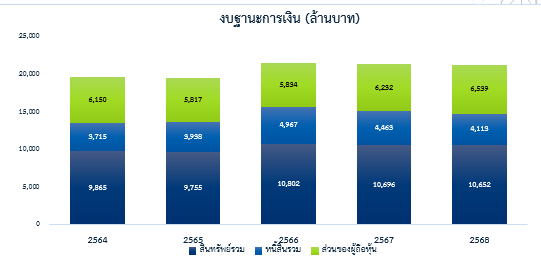
Total assets for 2025 amounted to 10,651.71 million Baht, a decrease of 44.78 million Baht or 0.42 percent from 2024, resulting from changes in various asset items as follows:
Current assets increased by 10.56 million Baht or 0.18 percent. The main reasons were:
Cash and cash equivalents decreased by 33.59 million Baht or 21.75 percent. This was because the company sought short-term returns by investing excess cash in short-term investments to maximize the efficiency of cash on hand, aiming to hold the minimum possible amount of cash.
Other current receivables increased by 31.00 million Baht or 29.81 percent. This was due to billing other debtors at year-end, an increase in contractor contracharges (a contracharge is a charge to subcontractors for using company resources), and billing other debtors for additional work, specifically repair work from the earthquake, which is another type of revenue for the company following the earthquake incident during 2025.
Advances to subcontractors decreased by 55.65 million Baht or 27.94 percent. This was due to high-value projects being completed during 2025. Currently, the company has gained credibility from steel suppliers, allowing it to order steel without advance payments, which is the reason for the decrease in advances to subcontractors compared to the previous year.
Current income tax assets decreased by 51.61 million Baht or 92.09 percent, which is consistent with the increase in profits, leading to a reduction in the value of withholding tax awaiting refund from the previous year.
Non-current assets decreased by 55.34 million Baht or 1.11 percent. The main reasons were:
Other non-current financial assets decreased by 135.31 million Baht or 25.35 percent. The main reason was the fluctuation in the value of available-for-sale securities due to economic conditions, resulting in a decrease in the value of investments in securities at the end of 2025 compared to the previous year.
Land, buildings, and equipment decreased by 67.76 million Baht or 2.67 percent. This was because, during 2024, the company's assets were gradually fully depreciated, although they remained fully operational. As a result, the asset value in 2025 decreased compared to the previous year.
Deferred income tax assets increased by 64.93 million Baht or 66.98 percent. The main reasons were temporary accounting and tax differences related to investments in securities, and an increase in estimated construction costs from the previous year.
Long-term loans to related parties and investments in joint ventures increased by 52.25 million Baht and 31.31 million Baht, respectively, or 56.89 percent and 25.59 percent, respectively. This was due to the company providing financial support to its subsidiaries and joint ventures to create business growth opportunities, enhance competitiveness, and increase future profits.
Current liabilities decreased by 119.08 million Baht or 3.83 percent. The main reasons were:
Other current payables decreased by 267.97 million Baht or 19.66 percent. The main reason was a significant reduction in the estimated construction costs for large projects, as they were in their final stages.
The portion of provision for employee benefits due within one year increased by 30.55 million Baht or 285.12 percent. The main reason was that the company revised its estimates due to changes in the assumptions used for the estimation.
Non-current liabilities decreased by 232.17 million Baht or 17.15 percent. The main reasons were:
Long-term loans decreased by 202.79 million Baht or 23.25 percent. The main reason was the repayment of bank loans according to contractual terms. Additionally, the subsidiary made extra loan repayments beyond the loan agreement, resulting in a significant reduction in loans during the year.
Shareholders' equity increased by 306.05 million Baht or 4.92 percent. The main reasons were:
Operating profit for 2025 amounted to 607.07 million Baht.
Dividend payments during the year amounted to 175 million Baht.
Other components of shareholders' equity decreased by 105.86 million Baht due to a decrease in the fair value of available-for-sale investments compared to the previous year.
Debt Securities with Financial Ratio Requirements
Debt Securities with Financial Ratio Requirements Issued?
No
Factors That May Affect Financial Condition
Factors or Incidents That May Materially Affect Financial Condition
Real Estate Construction Sector
The construction industry is considered one of the key mechanisms driving the country's economic development, as it is linked to numerous other business sectors such as real estate, construction materials, finance, and logistics. During 2026–2028, Thailand's construction business is projected to experience moderate growth, primarily supported by government infrastructure investment, industrial sector expansion, and foreign investment. However, the business also faces challenges from the global economic situation, volatility in construction material costs, and increased competition within the industry.
First, the growth trend of the construction business during 2026–2028 is expected to expand at a moderate level, with an average growth rate of approximately 2–4 percent per year. The main reasons stem from the gradual recovery of the Thai economy, coupled with continued significant government investment in stimulating the economy. Although the real estate sector, particularly certain types of residential projects such as condominiums and office buildings, may not fully recover due to fragile consumer purchasing power, infrastructure investment and industrial projects remain crucial drivers supporting the growth of the construction industry in the medium term.
Second, government infrastructure investment will remain a key factor influencing the expansion of the construction industry during this period. Several large-scale projects are likely to proceed continuously, such as electric train projects in Bangkok and its vicinity, double-track railway projects, intercity expressways (motorways), and the Eastern Economic Corridor (EEC) development projects, which include the development of ports, airports, and logistics infrastructure. These projects will generate significant construction value and create employment in related industries. However, most large projects typically require high investment and long operational periods, giving large contractors an advantage over small and medium-sized operators.
Third, private sector construction is projected to grow in certain business segments, particularly the construction of industrial factories, warehouses, and distribution centers, benefiting from the relocation of foreign companies' production bases and the expansion of the logistics sector in Southeast Asia. This trend aligns with the investment strategies of many countries seeking to diversify risks from relying on a single production base, thereby allowing Thailand to maintain its potential to attract foreign investment, especially in electric vehicles, electronics, and high-tech industries. However, certain types of real estate, such as office buildings and shopping centers, may experience slower growth due to changes in work patterns and consumer behavior.
Fourth, the competitive structure in the construction industry is likely to change, with large contractors playing an increased role. This is because current construction projects are larger and more complex, requiring significant technology, machinery, and capital. As a result, small and medium-sized operators face limitations in terms of capital and competitiveness. Furthermore, contractors with strong project management, cost control, and risk management capabilities will have opportunities to secure large projects and generate continuous revenue through a sufficient backlog of work.
Fifth, technology and sustainability concepts will play a crucial role in the future development of the construction business. The adoption of digital technologies such as Building Information Modeling (BIM) systems, automation in construction, and prefabrication will help increase operational efficiency, reduce costs, and shorten construction periods. Concurrently, Environmental, Social, and Governance (ESG) trends will necessitate construction projects to consider efficient energy use, reduction of greenhouse gas emissions, and the design of more environmentally friendly buildings.
However, the construction business also faces several risks that could impact the performance of industry operators, such as volatility in construction material prices, particularly steel, cement, and energy, as well as the risk of high interest rates, which may affect private sector investment decisions in real estate projects. Furthermore, delays in government budget approvals or disbursements could lead to postponements in the operational timelines of some construction projects.
In summary, the trend of Thailand's construction business during 2026–2028 shows moderate growth, primarily supported by government infrastructure investment and industrial sector expansion. However, operators in the industry must adapt to the changing business environment, including competition, technology, and sustainability trends. Effective cost management, operational efficiency improvement, and risk management will be crucial factors enabling the construction business to achieve stable long-term growth.
Hotel and Services Sector
Tourism and the hotel business are considered one of the main economic sectors that continuously generate income for Thailand, contributing a high proportion to the Gross Domestic Product (GDP). Considering the trends during 2026–2028, the hotel and tourism business is expected to continue its growth trajectory, despite challenges from the global economic situation, fluctuating purchasing power, and increased regional competition. However, supporting factors such as the recovery of international travel, government tourism promotion policies, and the development of transportation infrastructure will help drive the hotel and tourism services business back to stable growth in the medium term.
During 2026–2028, the number of international tourists visiting Thailand is expected to increase continuously, especially tourists from Asian regions such as China, India, South Korea, and ASEAN countries, which remain Thailand's primary markets. Furthermore, the opening of new flight routes and increased flight frequencies by various airlines will support international tourist travel, leading to higher demand for accommodation, hotels, and tourism activities, particularly in major tourist cities like Bangkok, Phuket, Chiang Mai, and Pattaya, as well as secondary tourist cities where the government has policies to promote tourism income distribution.
Another significant trend in the hotel business during this period is the changing behavior of tourists who increasingly prioritize travel experiences. Today's tourists do not merely focus on relaxation but also value cultural activities, local cuisine, health, and nature-based tourism. Consequently, hotel operators must adapt their service models to meet diverse demands, such as developing wellness tourism packages, eco-tourism, and cultural tourism, to create differentiation and add value to their services.
Regarding the competitive structure, the hotel business in Thailand is likely to face increased competition from both new hotel operators and alternative accommodation platforms, such as short-term rentals via online platforms. However, hotels with efficient management, high service standards, and the ability to create unique customer experiences will be able to maintain their competitiveness. Furthermore, large hotels and international chain hotels still hold advantages in terms of marketing systems, customer networks, and service standards.
During 2026–2028, digital technology will play an increasingly important role in the hotel and tourism business. Operators will adopt technology to enhance management efficiency and elevate customer experience, such as online room booking systems, contactless check-in systems, the use of customer data (Data Analytics) to analyze behavior and offer suitable promotions, as well as utilizing digital platforms for marketing and brand awareness.
However, the hotel business still faces several challenges, such as rising operating costs, particularly energy costs, labor wages, and building maintenance expenses. Furthermore, global economic uncertainties and geopolitical situations may impact international travel during certain periods. Therefore, operators must prioritize cost management, service quality development, and revenue generation from diverse channels.
In summary, Thailand's hotel and tourism business during 2026–2028 is projected to experience continuous growth driven by the recovery of international travel and support from government policies. However, increased competition and rising operating costs necessitate continuous adaptation by operators, particularly in developing services that create unique experiences, adopting technology for management, and promoting sustainable tourism, to maintain competitiveness and achieve stable long-term growth.